
Cheyenne County Criminal Docket Searches
Kansas CaseSearch is the first stop for a public Cheyenne County criminal docket. Accept the terms and pick the district-court location. You can search by case number, citation number, party name, or another offered type. Filters narrow results by case type, status, filing dates, or judicial officer. A CAPTCHA may appear along the way. The portal itself warns that its case information is not the official court record.
The portal is one channel, not the only one. If a public item is missing, use the terminal at the Cheyenne County courthouse. You can also ask Angela Sundstrom, Clerk of the District Court. She can supply the named record. Written requests may be mailed, hand-delivered, or sent by an accepted electronic method. Call 785-332-8850 to confirm the route. City-ordinance cases belong to the St. Francis or Bird City municipal clerk.
- Identify the filing court from the complaint, citation, or notice.
- Search with the most exact identifier available.
- Match county, filing date, case type, and party role.
- Read the public events index and note the desired filing.
- Use the clerk or terminal when the web entry is incomplete.
Cheyenne Criminal Filing Courts
Where a Cheyenne County criminal docket lives depends on the filing court. State criminal matters go to Cheyenne County District Court. Jury trials happen there too. That court belongs to the 15th Judicial District. St. Francis Municipal Court and Bird City Municipal Court each handle their own city-ordinance violations. A municipal citation is not automatically a district criminal case.
| Court | Typical record | Custodian |
|---|---|---|
| Cheyenne County District Court | State criminal and district traffic cases | Clerk of District Court |
| St. Francis Municipal Court | City ordinance cases | Municipal clerk |
| Bird City Municipal Court | City ordinance cases | Municipal clerk |
Check the court before reading a missing result. Kansas CaseSearch is not a guaranteed index for every municipal filing.
Criminal Dockets: What They Show
A public Cheyenne County criminal docket is an events index, not a full criminal history. It may show location, case number, and type. Filing date and status can appear as well. Public party roles, counsel, judicial officer, hearings, event descriptions, and disposition can appear too. Document links show up only when Kansas access rules permit them.
| Case number | Identifies the file; a safe newer pattern is ??-2022-CR-000001. |
|---|---|
| Type and status | Shows portal categories, not a full account of the outcome. |
| Parties and counsel | Lists public roles when available; a name match is not identity proof. |
| Events and settings | Records public hearings, filings, orders, or resets by date. |
| Disposition | Shows a public procedural outcome, subject to later activity. |
A portal printout is not certified. Certification comes from the clerk keeping the Cheyenne County criminal file.
Cheyenne Odyssey Case Numbers
The 15th Judicial District switched to Enterprise Justice Odyssey on July 11, 2022. Newer Kansas numbers follow a set pattern. Per the official Smart Search guide, they pair a county abbreviation with a four-digit year, a case-type code, and a six-digit number. Older files may use a year, type, and six-digit sequence instead. The guide does not confirm Cheyenne County's exact prefix. Guessing one can hide a valid result. Type the number exactly as printed. An older Cheyenne County criminal docket may have an index entry but no web document. Ask about the courthouse terminal. Converted documents may remain viewable there even without online download. The clerk can confirm the number shown on a notice.
Criminal Case Stages on the Docket
A Cheyenne County criminal docket can track a case through Filing → Arraignment → Pretrial → Plea or Trial → Disposition → Sentencing. Not every case uses each stage, and motions or continuances can alter the order.
- Arraignment
- A proceeding that addresses the charge and plea process.
- Setting
- A scheduled event that should be confirmed with the clerk.
- Continuance
- A court-approved move to another date, not a dismissal.
- Disposition
- The recorded procedural resolution of a case or charge.
- Sentencing
- The penalty stage after a qualifying disposition.
An entry shows what the court recorded. It proves no outside facts and never predicts the next ruling.
Cheyenne County Diversion Records
Cheyenne County has a written criminal diversion policy run by the County Attorney. Diversion is discretionary, not a judge-run specialty court or a public search portal. The policy requires a written application, and the County Attorney generally responds within 30 days. Eligibility turns on the charge and the policy.
Fees under the published policy are $200 for misdemeanors and $400 for level 8, 9, 10, or unclassified felonies. Level 6 or 7 felonies and level 4 drug felonies cost $600. Terms and payment methods also vary. Court costs may remain.
The official diversion policy controls. Its public page appears next.
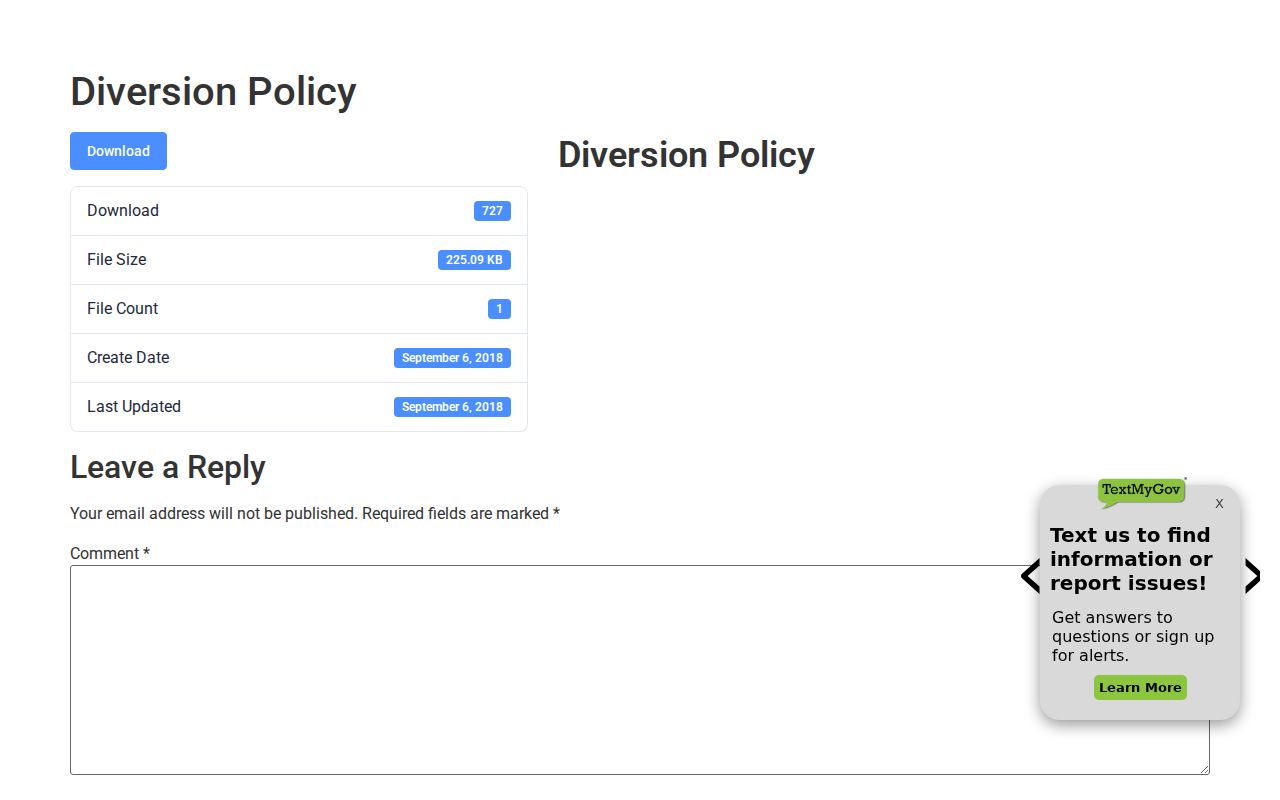
The policy confirms diversion has its own written path; it is not selected from a docket result.
Cheyenne County Criminal Docket Courts
District criminal files sit with Angela Sundstrom, Clerk of the District Court. The office is at 212 E. Washington Street, St. Francis, KS 67756, with mail to PO Box 646. Phone 785-332-8850, fax 785-332-8851. The administrative County Clerk is a separate office.
Cheyenne County District Court
212 E. Washington Street
PO Box 646, St. Francis, KS 67756
785-332-8850
Take diversion-policy questions to the County Attorney, not ordinary copies. Take a city filing to the municipal clerk. Right routing saves delay.
Cheyenne Warrant Record Limits
A missing warrant item does not mean no warrant or filing exists. Kansas Rule 22 governs public access to warrant information, supporting records, and sealed material. It was amended effective March 24, 2025, so older web advice may not match current access.
K.S.A. 22-2410 covers arrest-record expungement. The official statute page appears next.
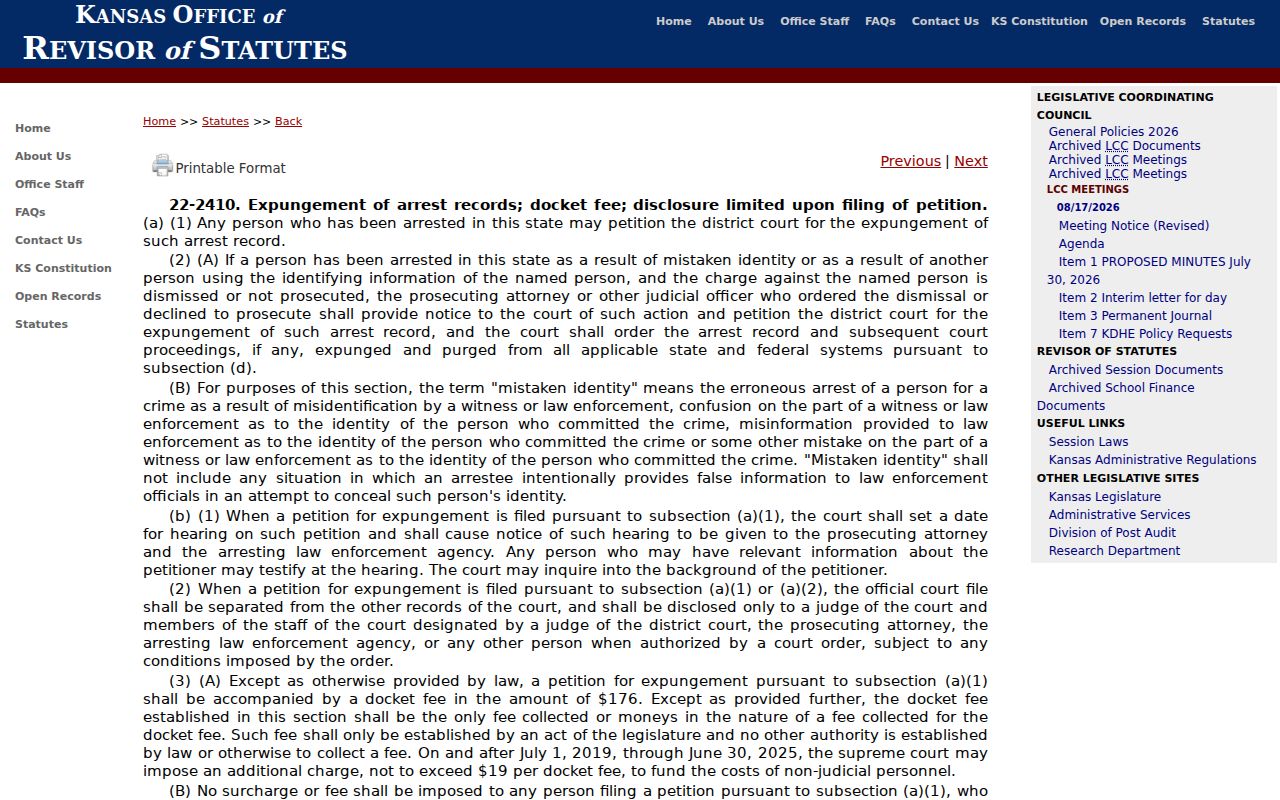
Restricted material is not an ordinary portal target. Ask the clerk what access is lawful rather than concluding anything from silence.
Access Rules for Criminal Dockets
Rule 22 separates index access from documents you can get by request or terminal. It shields juvenile, grand-jury, search-warrant, presentence, expunged, sealed, and other protected content. The Kansas Open Records Act does not override those court limits.
Key rules:
Kansas Rule 22 defines public court access and inaccessible categories.
K.S.A. 45-215 states open-records policy and definitions.
K.S.A. 45-221 lists records exempt from disclosure.
Name a public document precisely when you write the clerk. The 15th Judicial District describes a response within 72 hours. That promise is not production within 72 hours; review, redaction, retrieval, and a fee estimate can take longer.
Cheyenne Expungement Is Not Deletion
Expungement law in Kansas explains a puzzle many searchers hit. An older Cheyenne County criminal docket entry can vanish from public view. The case file still exists. K.S.A. 21-6614 covers how convictions, arrests, and diversion records get expunged. The statute page spells out what that means for public access.
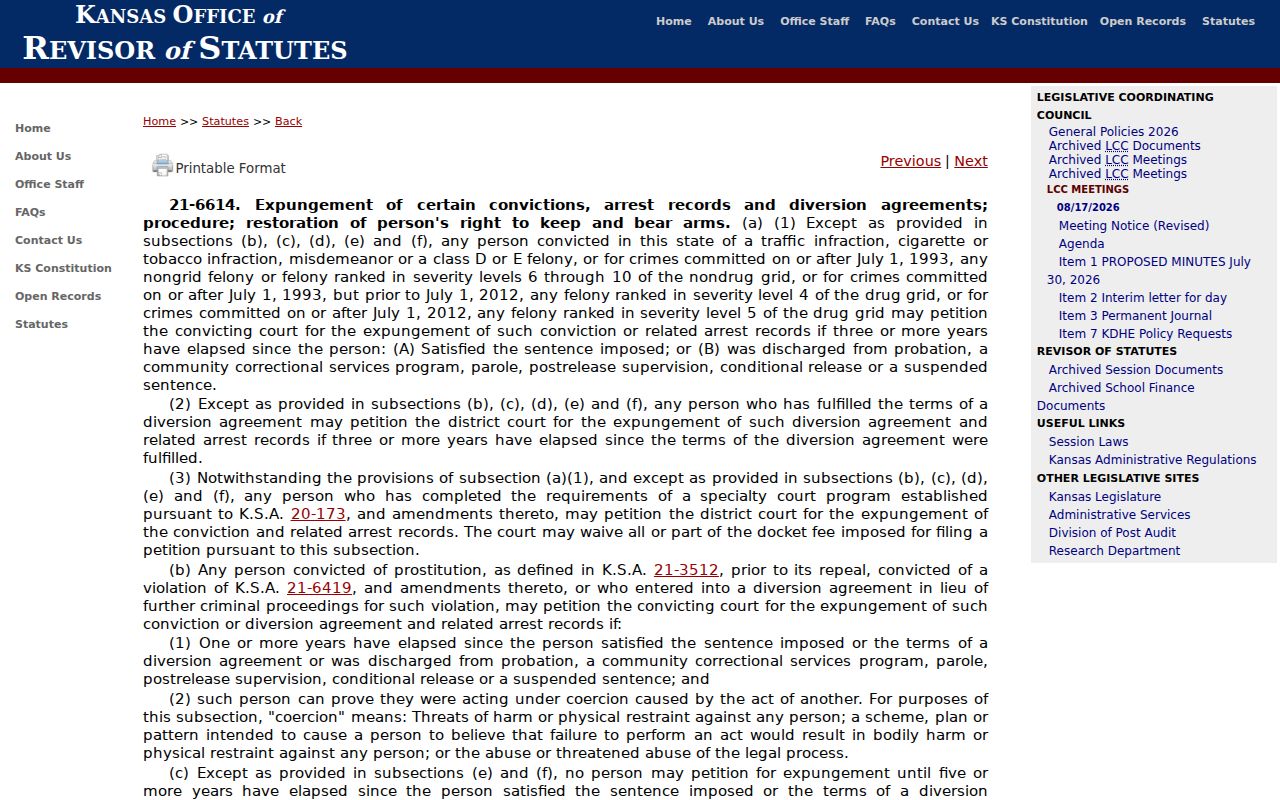
The law controls who may see a record. That is the whole point. So a missing entry proves nothing about a person's full history.
If an open record simply is not posted online, go to the terminal or send the clerk a precise request. A restricted record is different. Unofficial databases cannot lawfully fill that gap. For certified criminal records and lawful access, the official court remains the only source.
Cheyenne Criminal Record Requests
Name the court, the case number, the filing year, and the exact event you want. That is how you ask for an open Cheyenne County criminal docket document. The optional Kansas form goes further. It asks for your contact details, delivery preference, signature and date, plus the certification required by K.S.A. 45-230. Mail it or hand-deliver it to the district court custodian. You can also ask the clerk which electronic method she accepts.
Costs come from the district schedule. Copies run $0.25 per page, and certified documents cost $10 each. Mail, fax, and staff-preparation charges may apply. Expect a response within 72 hours. That response may be only an acknowledgment or an estimate rather than the record itself. Keep your wording narrow. It helps staff find the right public item and check restrictions fast.