
Cheyenne County Court Record Requests
Kansas CaseSearch is the best starting point for a remote docket search. It gives you a case number and a public index of events. Not every public document appears online, though. When something is missing, the 15th Judicial District records page points you to the courthouse public-access computer or the clerk's office. Every court keeps a public search terminal on site.
- Identify Cheyenne County District Court and the case number, if known.
- Name the exact public document or event index sought.
- Choose online review, courthouse terminal, counter pickup, mail, fax, or another offered delivery route.
- Submit the official written request when staff need to locate or copy the item.
- Ask for certification only when a clerk-authenticated copy is required.
A phone call can sort out basics fast. Staff can tell you which office holds the file. They can say whether it is available, and roughly what fees apply. A call will not substitute for a written request when the rules require one. For district civil, criminal, domestic, probate, juvenile, guardianship, care-and-treatment, small-claims, and district traffic records, the custodian is Angela Sundstrom. She is the Clerk of the District Court.
Three Cheyenne County Record Products
Cheyenne County hands out three distinct record products, and mixing them up leads to ordering the wrong thing or paying a fee you didn't expect. Know the difference before you request anything from the clerk.
| Product | What it provides | Best route |
|---|---|---|
| Public case information | Number, type, parties, judge, status, and event index where public | CaseSearch or courthouse terminal |
| Filed court document | A public complaint, petition, motion, order, or judgment | Portal link, terminal, or clerk request |
| Certified copy or transcript | Clerk-authenticated copy or prepared record of a proceeding | Separate clerk or transcript process |
CaseSearch itself warns that portal information is not the official record, and a copied page carries no certification. A docket line may confirm an order exists while saying nothing about what the order actually says.
Cheyenne County KORA Boundaries
Kansas public-record law starts with K.S.A. 45-215, the statute that frames how a member of the public may request records from the proper custodian.
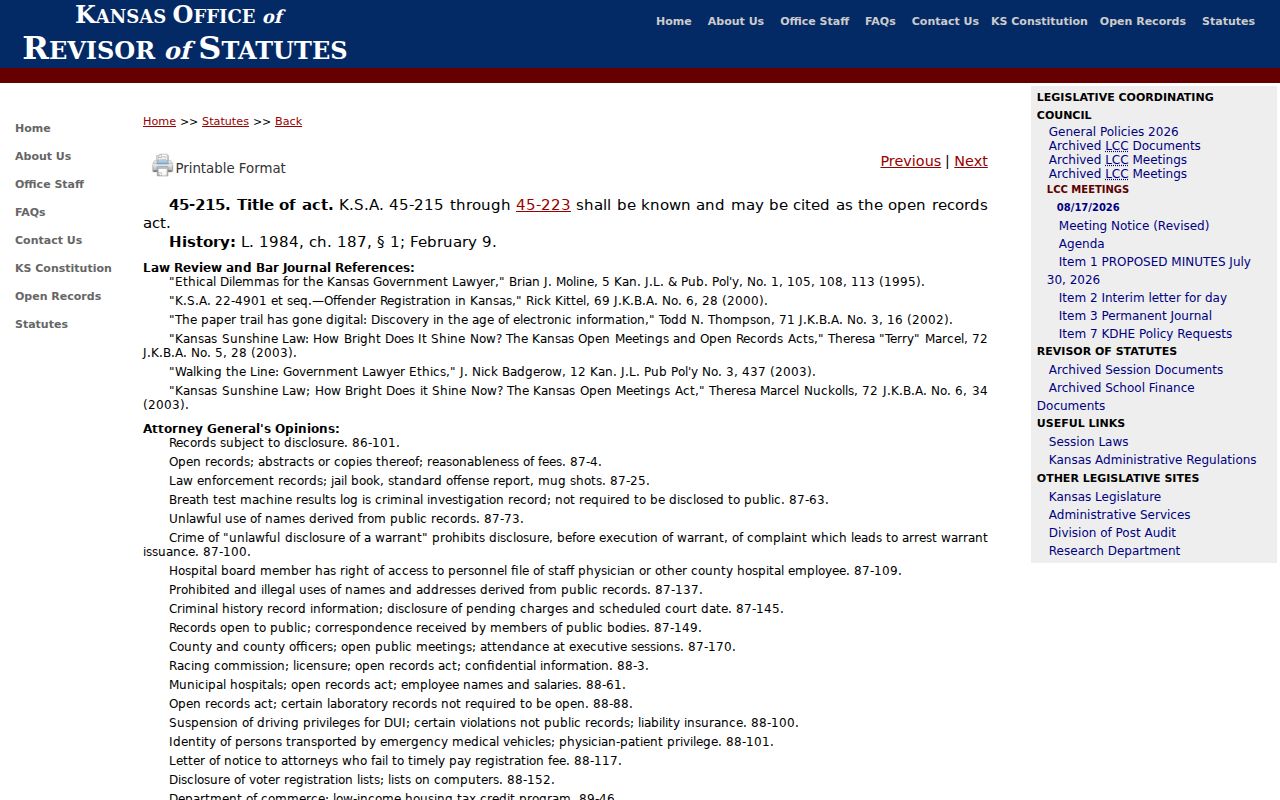
The statute favors open access, but it leaves court-specific rules and lawful restrictions in place. K.S.A. 45-221 sets out the exemptions and discretionary limits that apply.
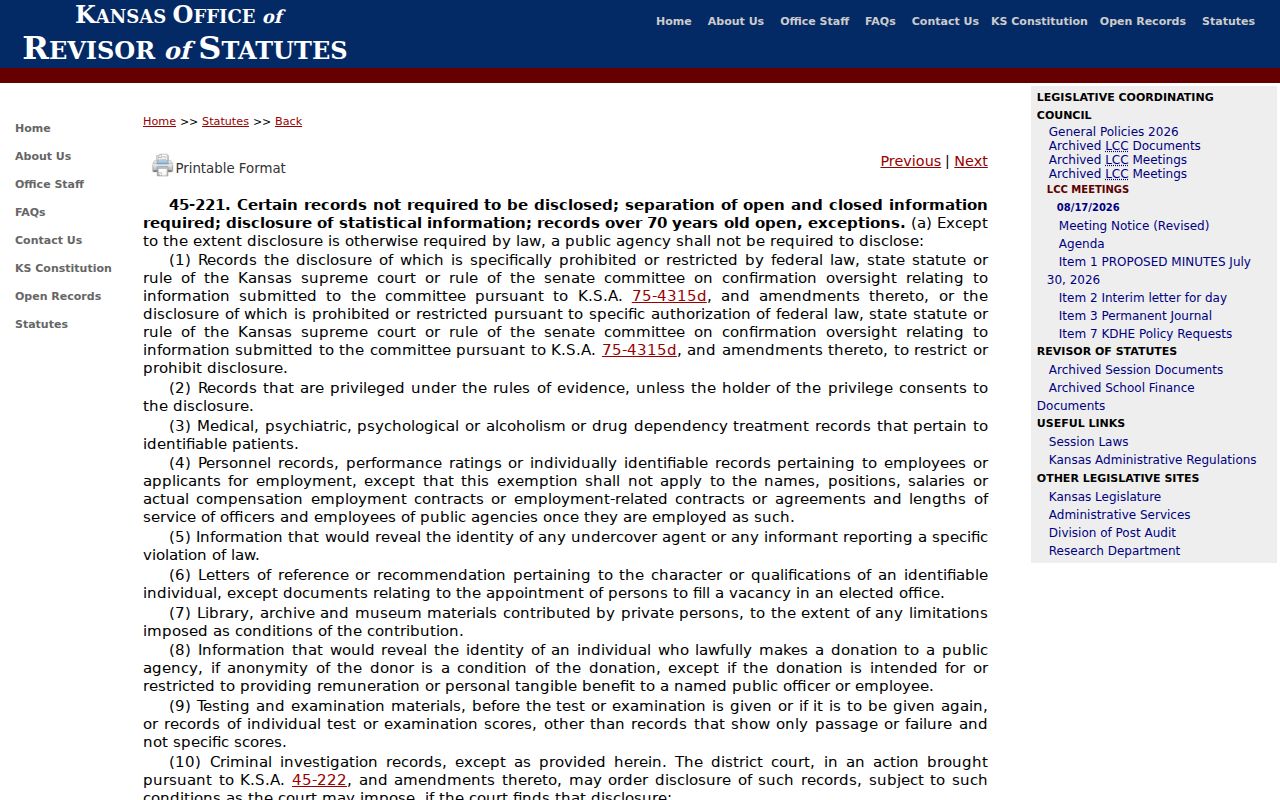
Those exemptions are why court staff may redact part of a public document or withhold protected content rather than hand over a complete file.
Kinds of Court Records
Cheyenne County District Court handles a wide range of trial matters. Its files can hold civil pleadings, criminal complaints and orders, domestic filings, probate papers, small-claims entries, guardianship records, traffic matters, and more. What the public may see depends on the case and the document.
- Complaints and petitions that begin a matter, where public
- Answers, motions, notices, and other filed papers
- Orders, judgments, and disposition entries available to the public
- Hearing and filing events in the public index
- Transcripts or recordings handled through the separate process
City-ordinance court records from St. Francis and Bird City sit with their own municipal clerks, not the district court. Note also that the county administrative Clerk is a separate office from the Clerk of the District Court.
Precise Cheyenne County Requests
The official Kansas court-record request form covers a lot of ground. It asks for the court, your details, a delivery choice, a record description, a signature, a date, and a noncommercial-use certification. Be specific, because a blanket request for all records costs more staff time and more money.
Be exact. Ask for the public judgment filed in a named case, a dated order, or the public event index for a stated year.
Add the Cheyenne County case number when you can. Say plainly whether you want a certified copy or a plain one. Skip sensitive personal details the staff do not need to find the file.
Court Records: What They Contain
What a court record contains depends on which document you hold. The public index maps the case; the filed paper carries its own text, sometimes with redactions.
| Caption | The court and public case title. |
|---|---|
| Case number | The unique court identifier used for retrieval. |
| Filing information | The filed date and document or event type. |
| Parties and roles | Public names and their procedural roles, when available. |
| Judicial action | The ruling, direction, or judgment stated in an accessible order. |
| Clerk authentication | A certification present only when the clerk issues a certified copy. |
An event line is not the order itself, nor a transcript, exhibit, or sealed attachment. Ask for the exact item you need.
Copy Fees and Certification
The district publishes set charges for copies of Cheyenne County court records. Requests that involve research, redaction, or preparation may come with an estimate, and third-party charges can apply on top.
| Item | Published amount |
|---|---|
| Copy page | $0.25 per page |
| Certified document | $10.00 per document |
| $0.50 first five pages; $0.25 each additional five pages | |
| Fax | $0.50 per page, maximum 15 pages |
| Custodian or clerical preparation | $20 per hour, quarter-hour increments |
| Professional preparation | $60 per hour, quarter-hour increments |
The district lists no separate search, docket-sheet, or web-access fee, but that is no promise of free staff work. Confirm the scope and estimate with the clerk before you order.
Older Cheyenne County Records
Cheyenne County joined the Odyssey case-management system with the rest of the 15th Judicial District in July 2022. Under the Smart Search guide, documents converted from the old FullCourt system are not viewable on the web. Some may still sit on the courthouse terminal. So an older case can show an index entry with no document link at all.
That missing link does not mean the record is sealed or lost. Ask the clerk where the item lives. It may be in the terminal collection, a paper file, microfilm, or the written-request system. The switch between systems left Cheyenne County with a mixed-era access problem. A document absent from the web can still be a public Cheyenne County court record. You can get it at the courthouse.
Transcripts Are Separate Records
A transcript is its own kind of court record. It is a written account of a recorded proceeding, not a copy of a filed paper. The 15th Judicial District transcript page spells out separate forms and Administrative Order 24-5. Most transcripts must be prepaid.
For the estimate, recording minutes are multiplied by .75 to project page count. Each transcript page, plus the cover and certificate, is billed at $3.50. To listen to an electronic recording, direct your request to the county clerk. Get the estimate first. A long hearing will not cost like a simple copy job.
Access Rules for Court Records
Kansas Rule 22 sets the rules for public access to court records and court events. It closes off adoption, juvenile, CINC, care-and-treatment, grand-jury, protected domestic, guardianship, poverty-affidavit, presentence, exhibit, and certain warrant records, and it took an amendment effective March 24, 2025.
For sealing, redaction, and closure, look to K.S.A. 60-2617.
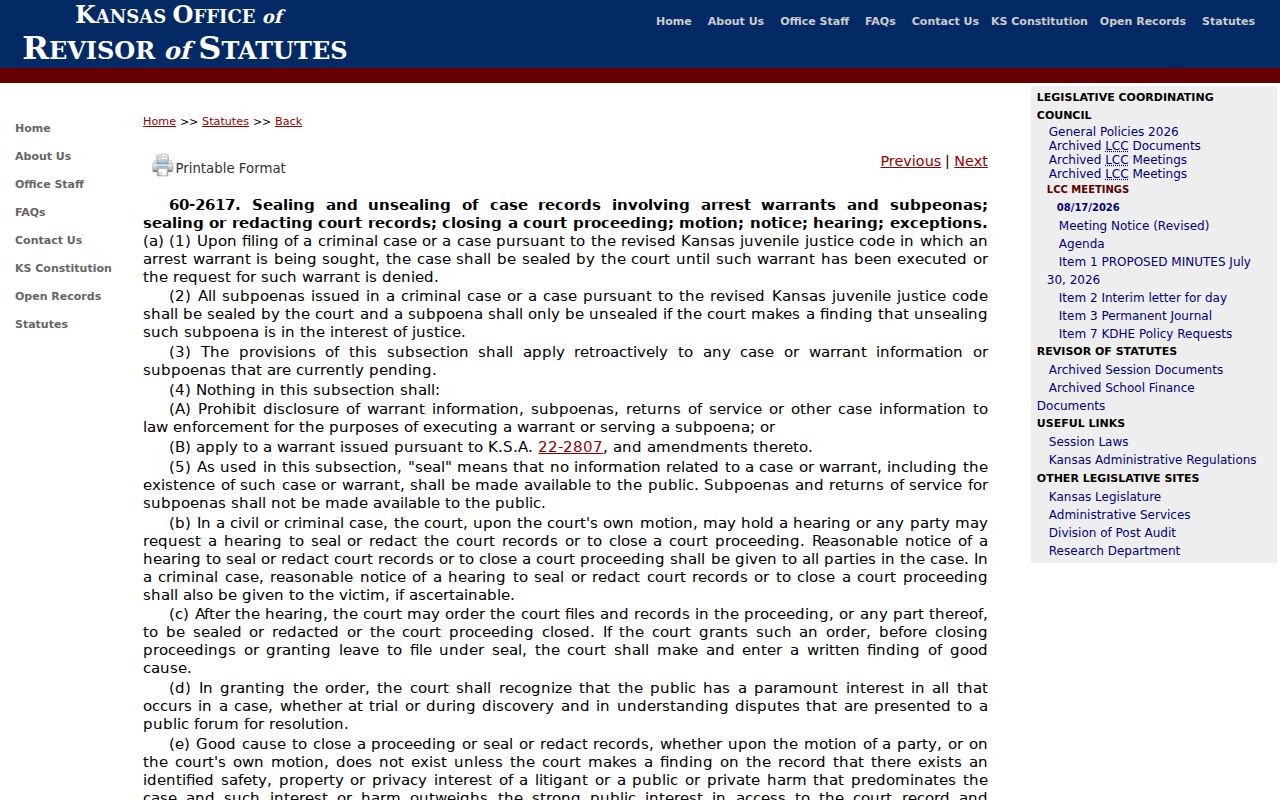
The statute balances public access against good-cause protection. A public case can hold a restricted document, and even a public document may need redaction.
Key access sources: Kansas Rule 22 controls court-record access; K.S.A. 45-215 states policy; K.S.A. 45-221 lists exemptions; K.S.A. 60-2617 addresses sealing and redaction.
Clerk of the District Court
Angela Sundstrom
212 East Washington Street
St. Francis, KS 67756
785-332-8850
Confirm public access, copy scope, delivery, and current hours before a visit.
Cheyenne County Response Timing
Kansas Open Records Act requests to Cheyenne County district records follow a 72-hour response rule. That clock measures the response, not delivery. Staff get three days to answer. The answer may be an estimate rather than the file itself. Locating the record, checking access limits, redacting protected details, and prep time all factor in. The Kansas rule number stays the same: 72 hours for a reply.
Help the clerk help you. A case number, a document title, a filed date, and a preferred delivery method make the request easy to fill. When fees come back, ask what drives the cost. Broad demands can shrink to the single order, judgment, or event index you truly need. Sometimes another office holds the record instead. It may be a city or federal custodian, and the clerk will say so.
Save the response with your request. If part of a record is withheld, read that answer next to Rule 22. Check whatever Kansas access rule the office cites too. The 72-hour window never overrides sealing, expungement, juvenile confidentiality, or any other lawful limit. And it never turns a records response into a ruling on the case.